Derivative Sport in Tornado Alley
Now, conditions in Central Illinois are from a mathematical perspective interesting and from a tennis perspective bad. The summer heat and wet-mitten humidity, the grotesquely fertile soil that sends grasses and broadleaves up through the courts’ surface by main force, the midges that feed on sweat and the mosquitoes that spawn in the fields’ furrows and in the conferva-choked ditches that box each field, night tennis next to impossible because the moths and crap-gnats drawn by the sodium lights form a little planet around each tall lamp and the whole lit court surface is aflutter with spastic little shadows.
But mostly wind. The biggest single factor in Central Illinois’ quality of outdoor life is wind. There are more local jokes than I can summon about bent weather vanes and leaning barns, more downstate sobriquets for kinds of wind than there are in Malamut for snow.
Autumn, usually about half as bad as spring, was a low constant roar and the massive clicking sound of continents of dry leaves being arranged into force-curves—I’d heard no sound remotely like this megaclicking until I heard, at nineteen, on New Brunswick’s Bay of Fundy, my first high-tide wave break and get sucked back out over a shore of polished pebbles. The wind would just die some August days, and it was no relief at all; the cessation drove us nuts.
The terrain’s strengths are also its weaknesses. Because the land seems so even, designers of clubs and parks rarely bother to roll it flat before laying the asphalt for tennis courts. The result is usually a slight list that only a player who spends a lot of time on the courts will notice.
None of the odd geometric claustrophobia that turns some gifted juniors into skittish zoo animals after a while. I found I felt best physically enwebbed in sharp angles, acute bisections, shaved corners. This was environmental. Philo, Illinois, is a cockeyed grid: nine north-south streets against six northeast-southwest, fifty-one gorgeous slanted-cruciform corners (the east and west intersection-angles’ tangents could be evaluated integrally in terms of their secants!) around a three-intersection central town common with a tank whose nozzle pointed northwest at Urbana, plus a frozen native son, felled on the Salerno beachhead, whose bronze hand pointed true north.
Midwest junior tennis was also my initiation into true adult sadness. I had developed a sort of hubris about my Taoistic ability to control via noncontrol.
Antitoi went wide west for a forehand cross and I saw the corn get laid down in waves and the sycamores in a copse lining the ditch point our way. There was no funnel. Either it had just materialized and come down or it wasn’t a real one. The big heavy swings on the industrial swingsets took off, wrapping themselves in their chains around and around the top crossbar; the park’s grass got laid down the same way the field had; the whole thing happened so fast I’d seen nothing like it; recall that Bi-mini H-Bomb film of the shock wave visible in the sea as it comes toward the ship’s film crew. This all happened very fast but in serial progression: field, trees, swings, grass, then the feel like the lift of the world’s biggest mitt, the nets suddenly and sexually up and out straight, and I seem to remember whacking a ball out of my hand at Antitoi to watch its radical west-east curve, and for some reason trying to run after this ball I’d just hit, but I couldn’t have tried to run after a ball I had hit, but I remember the heavy gentle lift at my thighs and the ball curving back closer and my passing the ball and beating the ball in flight over the horizontal net, my feet not once touching the ground over fifty-odd feet, a cartoon, and then there was chaff and crud in the air all over and both Antitoi and I either flew or were blown pinwheeling for I swear it must have been fifty feet to the fence one court over, the easternmost fence, we hit the fence so hard we knocked it halfway down, and it stuck at 45°, Antitoi detached a retina and had to wear those funky Jabbar retina-goggles for the rest of the summer, and the fence had two body-shaped indentations like in cartoons where the guy’s face makes a cast in the skillet that hit him, two catcher’s masks offence, we both got deep quadrangular lines impressed on our faces, torsos, legs’ fronts, from the fence, my sister said we looked like waffles, but neither of us got badly hurt, and no homes got whacked—either the thing just ascended again for no reason right after, they do that, obey no rule, follow no line, hop up and down at something that might as well be will, or else it wasn’t a real one. Antitoi’s tennis continued to improve after that, but mine didn’t.
damn that was a good essay
E Pluribus Unum
Most of the fiction writers I know are Americans under 40. I don’t know whether fiction writers under 40 watch more television than other American species. Statisticians report that television is watched over six hours a day in the average American household. I don’t know any fiction writers who live in average American households. I suspect Louise Erdrich might. Actually I have never seen an average American household. Except on TV.
It’s an incredible gauge of the generic. If we want to know what American normality is—i.e. what Americans want to regard as normal—we can trust television. For television’s whole raison is reflecting what people want to see. It’s a mirror. Not the Stendhalian mirror that reflects the blue sky and mudpuddle. More like the overlit bathroom mirror before which the teenager monitors his biceps and determines his better profile. This kind of window on nervous American self-perception is simply invaluable in terms of writing fiction. And writers can have faith in television. There is a lot of money at stake, after all; and television owns the best demographers applied social science has to offer, and these researchers can determine precisely what Americans in the 1990s are, want, see—what we as Audience want to see ourselves as. Television, from the surface on down, is about desire. And, fiction-wise, desire is the sugar in human food.
What classic voyeurism is is espial, i.e. watching people who don’t know you’re there as those people go about the mundane but erotically charged little businesses of private life. It’s interesting that so much classic voyeurism involves media of framed glass—windows, telescopes, etc. Maybe the framed glass is why the analogy to television is so tempting. But TV-watching is different from genuine Peeping-Tomism. Because the people we’re watching through TV’s framed-glass screen are not really ignorant of the fact that somebody is watching them. In fact a whole lot of somebodies. In fact the people on television know that it is by virtue of this truly huge crowd of ogling somebodies that they are on the screen engaging in broad non-mundane gestures at all. Television does not afford true espial because television is performance, spectacle, which by definition requires watchers. We’re not voyeurs here at all. We’re just viewers. We are the Audience, megametrically many, though most often we watch alone: E Unibus Pluram.
really interesting connection to emerson with like viewing stuff. probably somewhat grasping at straws but theres an interesting connection to nature’s invisible eye ball. interesting stuff on viewing and perspective and allat. dont think theres all that much to be said in that department but i do find it certainly interesting
The persons we young fiction writers and assorted shut-ins study, feel for, feel through most intently are, by virtue of a genius for feigned unself-consciousness, fit to stand people’s gazes. And we, trying desperately to be nonchalant, perspire creepily on the subway.
this is in e pluribus unum buts its from white noise
Several days later Murray asked me about a tourist attraction known as the most photographed barn in America. We drove 22 miles into the country around Farmington. There were meadows and apple orchards. White fences trailed through the rolling fields. Soon the signs started appearing. THE MOST PHOTOGRAPHED BARN IN AMERICA. We counted five signs before we reached the site. There were 40 cars and a tour bus in the makeshift lot. We walked along a cowpath to the slightly elevated spot set aside for viewing and photographing. All the people had cameras; some had tripods, telephoto lenses, filter kits. A man in a booth sold postcards and slides – pictures of the barn taken from the elevated spot. We stood near a grove of trees and watched the photographers. Murray maintained a prolonged silence, occasionally scrawling some notes in a little book.
“No one sees the barn,” he said finally.
A long silence followed.
“Once you’ve seen the signs about the barn, it becomes impossible to see the barn.”
He fell silent once more. People with cameras left the elevated site, replaced by others.
“We’re not here to capture an image, we’re here to maintain one. Every photograph reinforces the aura. Can you feel it, Jack? An accumulation of nameless energies.”
There was an extended silence. The man in the booth sold postcards and slides.
“Being here is a kind of spiritual surrender. We see only what the others see. The thousands who were here in the past, those who will come in the future. We’ve agreed to be part of a collective perception. This literally colors our vision. A religious experience in a way, like all tourism.”
Another silence ensued.
“They are taking pictures of taking pictures,” he said.
He did not speak for a while. We listened to the incessant clicking of shutter release buttons, the rustling crank of levers that advanced the film.
“What was the barn like before it was photographed?” he said. “What did it look like, how was it different from the other barns, how was it similar to other barns? We can’t answer these questions because we’ve read the signs, seen the people snapping the pictures. We can’t get outside the aura. We’re part of the aura. We’re here, we’re now”
He seemed immensely pleased by this.
from a blog about the excerpt—though to be formal, about the book about the excerpt—so this is the fourth level of reference
The challenge here is not to frame a good picture (you almost cannot miss), but to exclude the other photographer’s cameras, tripods or shadows (the sun rises behind your back), as seen for instance in this “behind the scenes” shot.
i dont find the rest of e pluribus unum all too interesting
getting away from already pretty much being away from it all
I imagine Credentials to be a small white card in the band of a fedora. I’ve never been considered Press before. My main interest in Credentials is getting into rides and stuff for free.
Plus the responsibility it conferred: if the whole of the world dissolved and resolved each time I blinked, what if my eyes didn’t open?
rest is like… good prose but im not particularly interested, skimmed
greatly exaggerated
writing is a better animal than speech because it is iterable; it is iterable because it is abstract; and it is abstract because it is a function not of presence but of absence: the reader’s absent when the writer’s writing, and the writer’s absent when the reader’s reading.
literary language as not a tool but an environment. A writer does not wield language; he is subsumed in it. Language speaks us; writing writes; etc.
critics can try to erase or over-define the author into anonymity for all sorts of technical, political, and philosophical reasons, and “this ‘anonymity’ may mean many things, but one thing which it cannot mean is that no one did it.”
david lynch keeps his head
ok. dont think ill really be interested in this but its about his dune so like.. . . .
ok skipped like 60% or so. like idc. film history from 20th century holds no interest for me
tennis player Michael Joyce’s professional artistry as a paradigm of certain stuff about choice, freedom, limitation, joy, grotesquerie, and human completeness
see i think dfw’s prose only exists to justify word count .. . so he can write stupid introductions detailing the femtosecond and the three words of a meter squared
sloppily beautiful
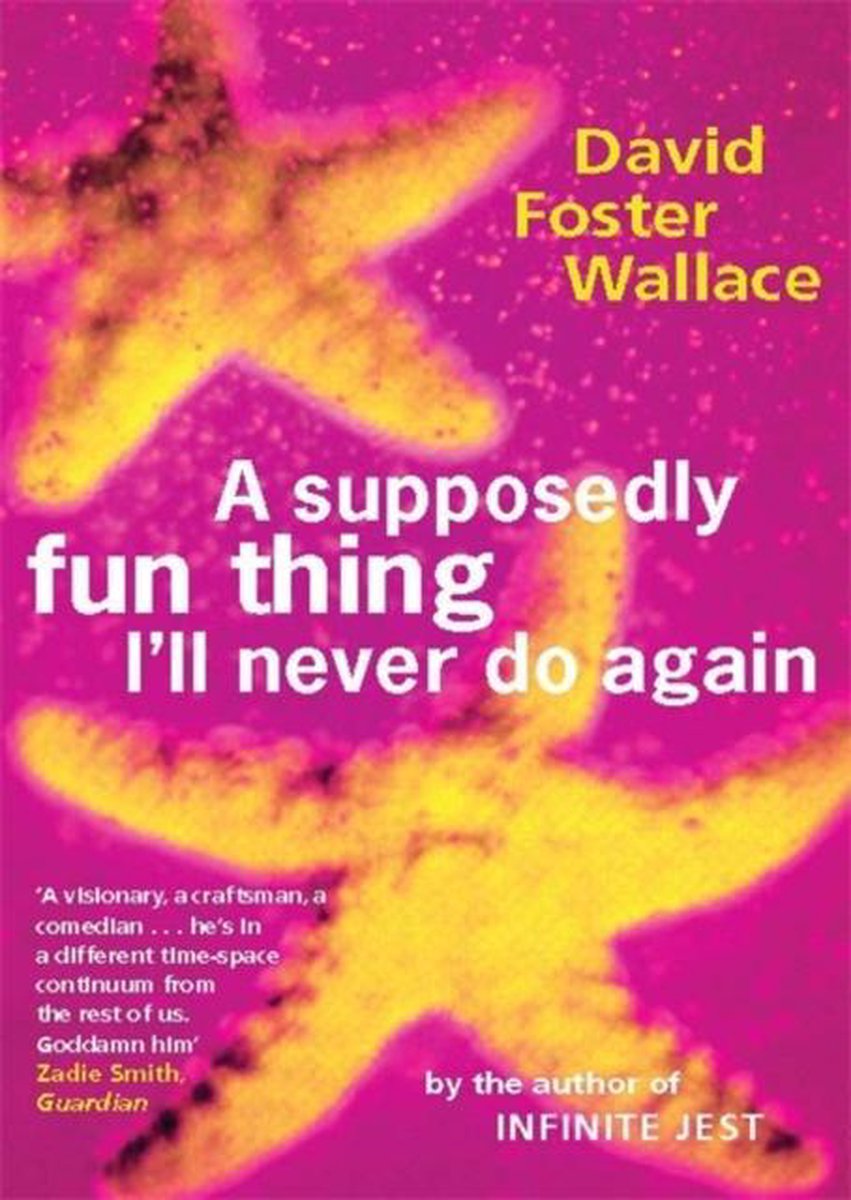
a supposedly fun thing i’ll never do again
this is like a marvel movie wow thats the namesake
oh i've been to hemingway house too
145 cats
But it’s also still a bona fide product—it’s supposed to be produced in you, this feeling: a blend of relaxation and stimulation, stressless indulgence and frantic tourism, that special mix of servility and condescension that’s marketed under configurations of the verb “to pamper.” This verb positively studs the Megalines’ various brochures: “… as you’ve never been pampered before,” “… to pamper yourself in our Jacuzzis and saunas,” “Let us pamper you,” “Pamper yourself in the warm zephyrs of the Bahamas.”
The fact that contemporary adult Americans also tend to associate the word “pamper” with a certain other consumer product is not an accident, I don’t think, and the connotation is not lost on the mass-market Megalines and their advertisers. And there’s good reason for them to iterate the word, and stress it.
“I predict this’ll get cut by the editor” i don't like this line if you're wrong its humilitating and if you're right the gratification must be so low
Seawater corrodes vessels with amazing speed—rusts them, exfoliates paint, strips varnish, dulls shine, coats ships’ hulls with barnacles and kelp-clumps and a vague ubiquitous nautical snot that seems like death incarnate. We saw some real horrors in port, local boats that looked dipped in a mixture of acid and shit, scabbed with rust and goo, ravaged by what they float in.
Not so the Megalines’ ships. It’s not an accident they’re all so white and clean, for they’re clearly meant to represent the Calvinist triumph of capital and industry over the primal decay-action of the sea. The Nadir seemed to have a whole battalion of wiry little Third World guys who went around the ship in navy-blue jumpsuits scanning for decay to overcome. Writer Frank Conroy, who has an odd little essaymercial in the front of Celebrity Cruises’ 7NC brochure, talks about how “It became a private challenge for me to try to find a piece of dull bright-work, a chipped rail, a stain in the deck, a slack cable or anything that wasn’t perfectly shipshape. Eventually, toward the end of the trip, I found a capstan with a half-dollar-sized patch of rust on the side facing the sea. My delight in this tiny flaw was interrupted by the arrival, even as I stood there, of a crewman with a roller and a bucket of white paint. I watched as he gave the entire capstan a fresh coat of paint and walked away with a nod.”
Contrast this coyness with the force of the 7NC brochure’s ads: the near-imperative use of the second person, the specificity of detail that extends even to what you will say (you will say “I couldn’t agree more” and “Let’s do it all!”). In the cruise brochure’s ads, you are excused from doing the work of constructing the fantasy. The ads do it for you. The ads, therefore, don’t flatter your adult agency, or even ignore it—they supplant it.
And this authoritarian—near-parental—type of advertising makes a very special sort of promise, a diabolically seductive promise that’s actually kind of honest, because it’s a promise that the Luxury Cruise itself is all about honoring. The promise is not that you can experience great pleasure, but that you will. That they’ll make certain of it. That they’ll micromanage every iota of every pleasure-option so that not even the dreadful corrosive action of your adult consciousness and agency and dread can fuck up your fun. Your troublesome capacities for choice, error, regret, dissatisfaction, and despair will be removed from the equation. The ads promise that you will be able—finally, for once—truly to relax and have a good time, because you will have no choice but to have a good time.
Apparently Ft. Laud. Airport is always just your average sleepy midsize airport six days a week and then every Saturday resembles the fall of Saigon.
There’s a bumpy false ceiling of mackerel clouds moving in from the southwest, but overhead it’s just wispy cirrus, and it’s seriously hot standing and waiting in the sun, even without luggage or luggage-angst, and through a lack of foresight I’m wearing my undertakerish black wool suitcoat and an inadequate hat.